We use cookies to make your experience better. To comply with the new e-Privacy directive, we need to ask for your consent to set the cookies. Learn more.

Adjustable Gas Struts
Adjustable gas struts, also known as variable force gas struts, are designed with a pressure release valve, allowing you to degas the to your desired force.
Our extensive range of adjustable struts are the ideal solution for prototypes, replacement applications, and situations where the exact force required is unknown. This saves time as it eliminates the need to send the strut back and forth to us, and money, as you will spend less than what you would on custom gas struts.
Our variable gas struts are available with rod diameters ranging from 6 mm to 28 mm, and forces from as little as 30N, all the way up to 10,000N. The range of stroke lengths, rod diameters, and forces makes our variable pressure gas struts suitable for both light and heavy-duty applications, with stainless steel options available for corrosive environments. We have in-house technical support ready to assist you in ordering the correct strut for your application’s requirements.
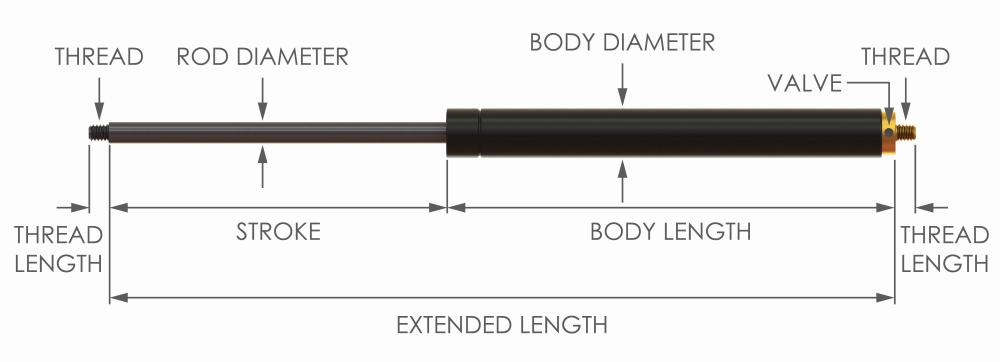
NS-V Core Gas Strut Range
Used widely in various industries and applications, Metrol's NS-V-10 gas strut range is also suitable for domestic, commercial and industrial environments.
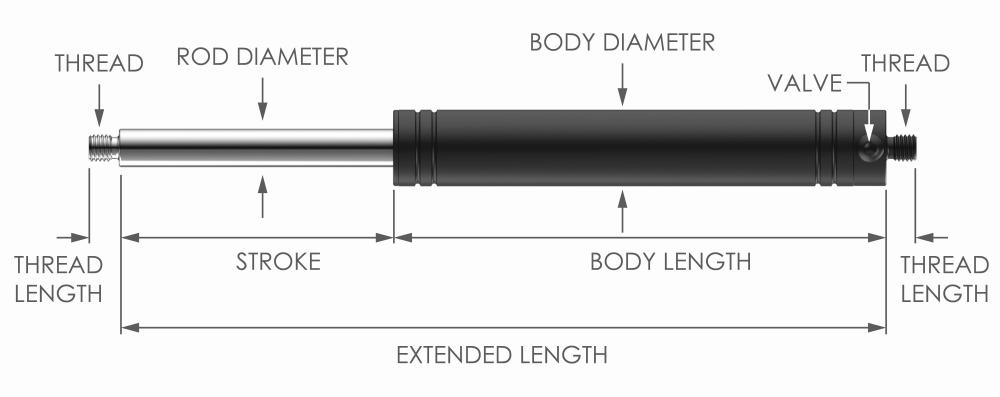
NS Advanced NitroSpring Range
Metrol's NS-10-28 Long Stroke NitroSprings are manufactured with added guidance, as well as triple rod wiper systems and premium sealing technology, a combination which prevents an ingress of contaminants, particularly useful for industrial applications. Additionally, the ability to adjust the force in the field provides added convenience and guarantees performance.
-
- Product Name
- Stroke (mm)
- Extended Length (mm)
- Rod Diameter (mm)
- Body Diameter (mm)
- Force Range (N)
- Force Progression (%)
- Threads
Shop Adjustable and Variable Force Gas Struts
When choosing the correct adjustable gas strut, we recommend working through the filters on the left, starting with stroke length, extended length, rod diameter, and body diameter, then moving on to force range, force progression (if necessary), and threads. Smaller diameter standard gas struts cover lower force requirements, while our larger struts best suit applications requiring substantially larger forces. However, if you cannot find a strut that meets your requirements, we offer custom gas struts made specifically for your application.
If you are unsure of what specifications you need, please use our gas strut design service or get in touch with our technical team.
What is an Adjustable Gas Strut?
Adjustable gas struts, like fixed-force gas struts, are constructed from a piston rod, body, nitrogen gas, oil, and sealing systems. Therefore, they operate similarly to standard struts, but the difference is that the user can simply reduce the pressure within the strut, resulting in a smaller extension force.
How Do Adjustable Gas Struts Work?
Compressed nitrogen gas sits within the body, creating continuous outward pressure that extends the piston rod out of the body. Oil is present too, and as the rod compresses into the body, it flows through an orifice, resulting in damping.
When compressed, the strut attempts to return to its resting position at full extension. This makes gas struts the ideal solution for lifting or safely controlling moving components, as they take pressure off the operator.
When you receive your adjustable gas strut, it will be charged to the maximum force within the range you selected. This force can then be reduced through the pressure release valve until the required performance is achieved.
What Are the Benefits of Adjustable Gas Struts?
Find the Correct Force Through Adjustment
In situations where the force required is unknown, using adjustable force gas struts provides a major advantage over fixed force gas struts. This is because the strut will arrive charged to the top of the range you selected, and you can then reduce the force gradually until the required force is achieved. This is also particularly useful when it is difficult to calculate the force required, or if the application has multiple variable forces throughout.
Ideal for Prototypes and Product Development
Adjustable gas struts are commonly used when prototyping, as it allows design engineers to test various forces before committing to a specific one. By using one strut for this, you can speed this process up significantly, rather than waiting for various gas struts to arrive or having to order new ones at forces you didn’t think you'd need.
Variable force struts are beneficial when developing products, as it allows the designers to adjust the force as the application is changing and evolving. Especially useful when a final force hasn’t been determined yet.
When testing how applications perform under certain conditions, such as light and heavier loads, you can use a variable strut instead of removing and reinstalling several fixed force struts. This helps testers to quickly identify which strut should be used for which load.
When validating designs, using a variable strut will allow the engineer to test each specific force. Once they have approved a set force for the application, they can send the struts back to us, and we can check how much pressure is in them. From there, the engineer will know the exact force they require and can place an order for multiple fixed force struts.
Suitable for Replacement Applications
One problem is that people would like to replace the current gas struts they have with new ones, but they do not know the force in the original struts. This may be because the product markings are missing, and one way to work around this is to estimate the force range based on the weight the strut needs to lift. Once this is determined, we can send you adjustable-force gas strut replacements that you can degas until the desired force is achieved.
If an application has been modified and the weight has changed, it is likely you’ll need new struts. In this case, ordering adjustable gas struts charged to a similar range as your existing ones allows you to quickly install suitable replacements.
One Strut for Different Application Variants
Ordering one type of adjustable force gas struts can be useful when similar applications have different lid weights, panel sizes, or operating requirements. For example, two applications may be the same size, but have different panel weights. Instead of ordering two separate fixed force struts, you could order two of the same variable force struts and simply degas them to different amounts. This would also reduce costs when ordering large quantities as we offer volume discounts.
Potential Alternative to a Custom Gas Strut
You may think you need a custom gas strut, when sometimes an adjustable strut would be suitable. If the dimensions of our standard adjustable gas struts meet your requirements, the ability to vary the force may provide a practical alternative to a completely custom strut. Even in corrosive environments, a custom solution isn’t always necessary, as we have stainless steel struts built to perform in these conditions.
How to Adjust the Force of a Gas Strut
Use a 2mm allen key to undo the grub screw on the pressure release valve anti-clockwise a quarter turn. Vent the gas for one second at a time, retighten the grub screw and test after each short burst. You mustn't tighten the grub screw more than necessary.
Once you have found the desired force, repeat this process for the other gas struts, being careful to release the same amount of pressure.
An approximation is that each one second burst will reduce the force by roughly 20N to 50N, but this is range-dependent.
Once you have done this, test the application with all struts installed. If the nitrogen gas struts are too powerful, continue to release equal pressure from each one.
After reducing the pressure in all struts and confirming you are happy with the force, brush the grub screw gently with washing up liquid. If you can see gas bubbling through, then you need to tighten the screw more.
If you have released too much gas, please get in touch with us, and we can book them in to get recharged.
Gas struts are filled with high-pressure nitrogen gas; they should be protected from damage. Do not open, modify, drill, weld or subject gas struts to excessive heat.
Adjustable vs Fixed Force Gas Struts
An adjustable force strut arrives charged to the top of a specific force range and can be degassed by the user until the required force is achieved. This is ideal for applications where the necessary force is unknown. Fixed force gas struts are charged to a specific force, and the pressure cannot be adjusted. Fixed force struts are ideal for use when the force is known.
Adjustable Gas Struts
Adjustable struts are suitable for use when the application is being prototyped, testing is required, different application variants require different forces, or an existing strut needs replacing but the force is unknown.
Fixed Force Gas Struts
Fixed force struts should only be used when the exact force requirement is known, a repeatable pre-set force is required, or the application’s requirements have been established.
How to Choose the Right Adjustable Gas Strut
Determine the stroke required. This is the distance travelled by the piston rod between its compressed and extended positions.
Determine what extended length you need. You should also account for end fittings to ensure the complete length of the strut will fit into your application.
Check which rod and body diameters fit into your application. For standard gas struts, larger diameters will accommodate higher forces.
Select an appropriate force range based on the weight of your application.
Panel Weight
Whilst panel weight alone isn’t enough to determine the force required, because mounting positions and other variables should be considered, it will still affect the required force and should therefore be weighed.
Mounting Positions
When a strut is mounted at an angle, it creates side loading, which puts additional pressure onto the rod from the side. Therefore, we generally recommend using ball joints if there is a possibility of side loading, to protect the lifespan of the strut.
End Fittings and Brackets
We stock the following end fittings:
- Ball ends
- Eye ends
- Clevis forks
- Rose eyes
- Mounting brackets
We also stock gas strut accessories, including locking tubes, which keep your struts extended in place as an additional safety feature; in the rare occasion that struts suddenly lose pressure, the application wouldn’t slam shut.
Another accessory available is our gas strut dust covers, which keep dust, dirt, and debris out of the strut, therefore prolonging the seals and lifespan.
Our protection tubes protect the full length of the stroke from any unexpected dents or damage.
Adjustable Gas Strut Force Ranges
Our standard adjustable gas struts are available in the following force ranges:
- 30 – 400N
- 50 – 650N
- 70 – 1200N
- 150 – 2500N
- 230 – 1400N
- 300 – 5000N
- 450 – 2700N
- 450 – 2750N
- 930 – 5650N
- 1450 – 8700N
- 1800 – 10000N
Stainless Steel Adjustable Gas Struts
Our stainless steel variable struts are made from grade 316, which provides an ultimate level of resistance against corrosion.
Stainless Steel Variable Force Gas Strut Applications
Our stainless steel struts can be regularly sterilised, and they withstand corrosion and rust, making them suitable for the following industries:
- Marine
- Food processing
- Medical
- Packaging machinery
Please see our stainless steel gas strut page for the full benefits of this range.
Common Adjustable Gas Strut Applications:
- Car bonnets
- Car boots and tailgates
- Cupboards
- Storage beds
- Access hatches
- Industrial machinery
- Heavy panels
- Prototype equipment
- Enclosures
Why Choose Metrol for Adjustable Gas Struts?
Our extensive gas strut expertise allows us to provide you with technical design support and custom gas strut solutions. We also have a gas strut design service, which is particularly useful if you are unsure of what strut you’d need. Not to mention, our UK manufacturing capabilities, combined with the supply and logistics network of the Lesjöfors Group, allow us to deliver volume orders with rapid turnaround times.
Shop our wide range of adjustable gas struts today, with both steel and stainless steel options available.
Buy Adjustable Gas Struts Online
Browse our variable gas struts today, filter your way through the stroke lengths, diameters, and force required, and then select compatible accessories. If you are unsure which strut would work for your application, our gas strut design service is available. Please contact Metrol for any technical assistance.
Frequently Asked Questions
Can you increase the force after reducing it?
Once pressure has been released, the user cannot simply increase the force again. If too much gas is released, please send the strut back to us for recharging.
What is the difference between adjustable and fixed force gas struts?
An adjustable gas strut allows the force to be reduced to suit the application. A fixed force gas strut is supplied at a specified force that cannot be adjusted by the user.
When should I use an adjustable gas strut?
Adjustable gas struts are particularly useful when the required force is unknown, when replacing a strut with an unknown force rating, during prototyping or when similar applications require different force levels.
How do I choose the correct adjustable gas strut?
Consider the required force range, stroke, extended length, rod diameter, body diameter, mounting positions and application weight. Technical guidance is recommended where the correct specification is uncertain.
Are adjustable gas struts suitable for heavy-duty applications?
Yes. Adjustable gas struts are available across a range of sizes and forces, including options designed for applications requiring substantially higher forces. The correct product should be selected according to the specific application requirements.
Are stainless steel adjustable gas struts available?
Yes. Stainless steel adjustable gas struts are available for applications where increased corrosion resistance may be required. Always check the specific material and product specification for the intended operating environment.