We use cookies to make your experience better. To comply with the new e-Privacy directive, we need to ask for your consent to set the cookies. Learn more.

Damped Gas Struts
Inside a gas strut, there is both nitrogen gas and oil, which provide the force and damping properties. Damping is determined by the size of the metering orifice within the strut. If it is smaller, it will take the oil longer to pass from one side of the strut (the body) to the other (the piston rod), resulting in slower damping.
Different damping directions are available to control the movement of the strut in a way that’s best suited to the application. Extension damping stops the application from opening too fast by slowing down the strut’s opening movement. Compression damping works oppositely, and it prevents the application from closing too quickly by slowing the strut’s motion as it closes. Bi-directional damping, also known as dual damping, controls both the extension and compression speed of the strut to ensure a soft opening and closing. End-of-stroke damping will only slow down the last part of the strut's travel, suitable for when the user wants a soft-close without adding resistance across the whole stroke.
The amount of damping in a gas strut is displayed in percentages. If a strut is damped by 70%, the compression/extension speed will be slower, and there will be greater resistance, in comparison to a strut only damped by 30%. Our gas struts can be damped to any percentage and therefore tailored to your application.
-
- Product Name
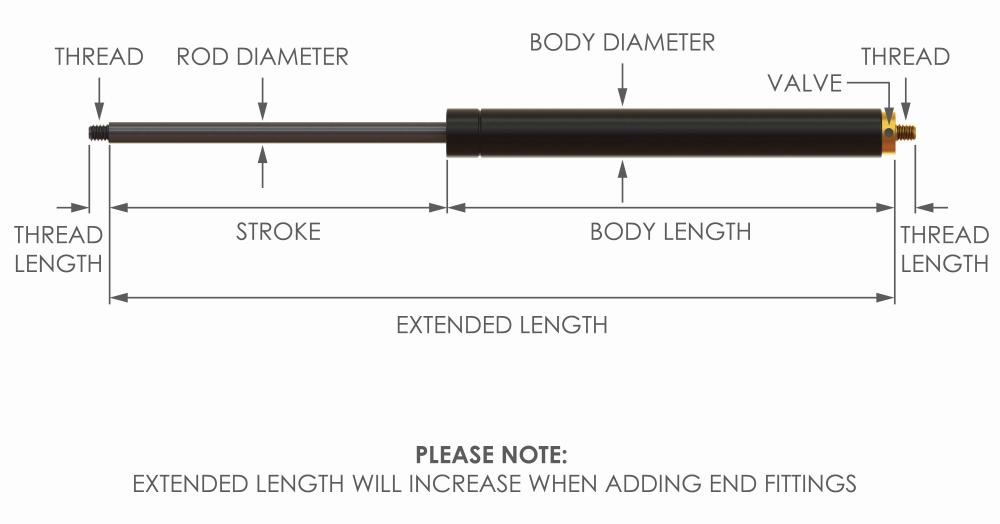
- Stroke
- Extended Length
- Rod Diameter
- Body Diameter
- Force Range
- Force Progression
- Threads